




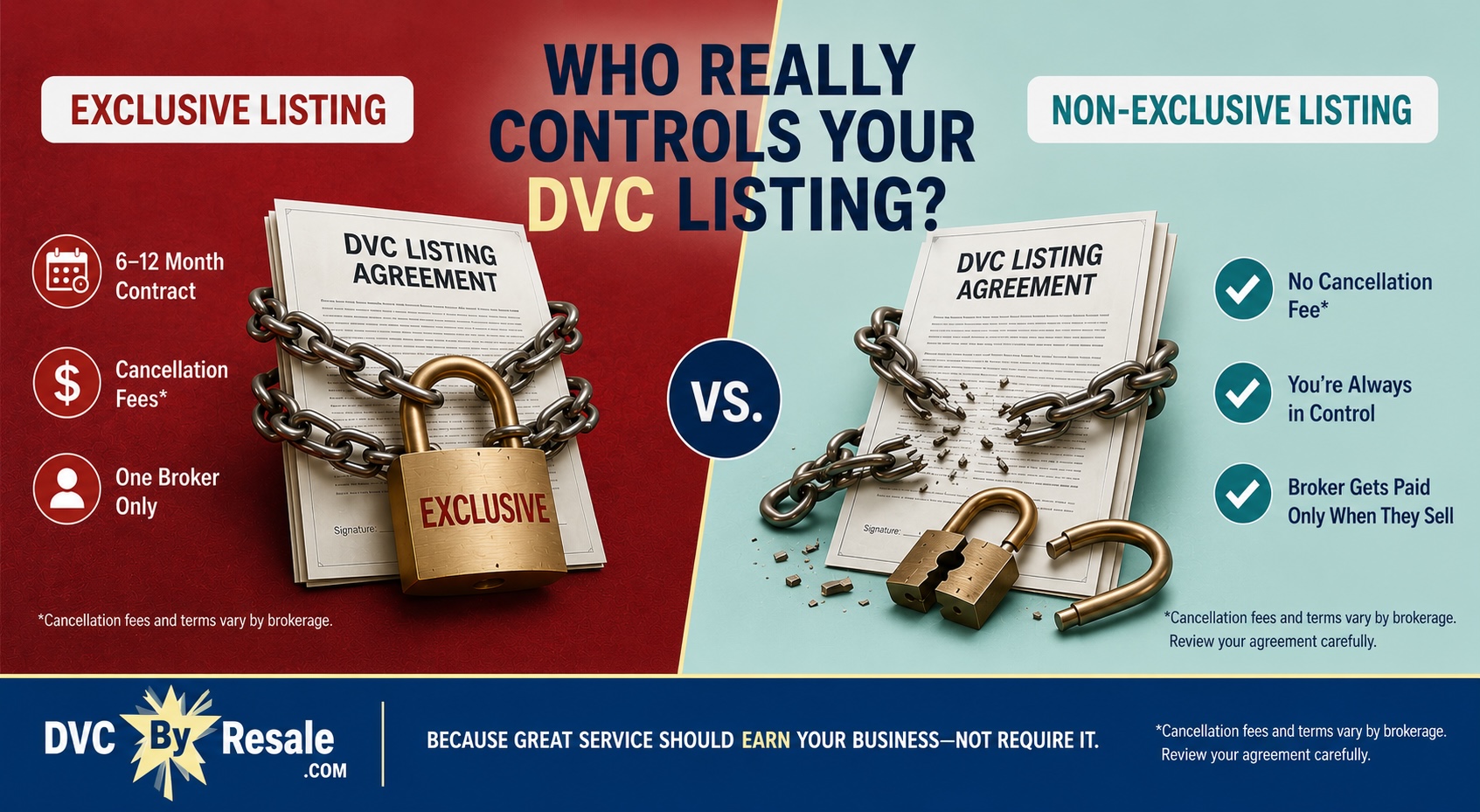
Before signing a DVC resale listing agreement, it's important to understand one key difference that many sellers overlook: whether the agreement is exclusive or non-exclusive. That single decision can affect your flexibility, your ability to change brokers, and even whether you could owe money if you decide not to sell.
The type of agreement you sign can determine how much flexibility you have, whether you can change brokers, whether you can sell the contract yourself, and even whether you owe money if you decide not to sell.
Understanding these differences before you sign can save you both frustration and unexpected costs. Generally, DVC resale brokers use one of two types of listing agreements:
Exclusive Right-to-Sell OR Non-Exclusive Right-to-Sell
What Is an Exclusive Right-to-Sell Agreement? (used by some brokers, including some recommended by DVC administration)
With an exclusive right-to-sell agreement, you give one brokerage the exclusive authority to market and sell your DVC contract for a specified period, often six months to one year.
During that time:
- You cannot list your contract with another resale broker.
- You generally cannot sell the contract yourself without paying that brokerage a commission or fee.
- If you decide you no longer want to sell, canceling the agreement may involve a cancellation fee or other penalties, depending on the terms of the contract.
- Some brokerages include early termination or cancellation fees that can be several hundred dollars.
An exclusive agreement may work well for some sellers because:
- The broker may invest additional time and resources promoting the listing. (Many non-exclusive brokers also make significant investments in marketing their listings.)
- There is only one asking price in the marketplace, which can reduce potential buyer confusion.
Exclusive agreements also come with tradeoffs. Depending on the brokerage agreement, sellers may find that:
- They are committed for many months, even if the broker isn't actively promoting their property.
- They cannot try another broker if they're unhappy with the level of service, communication, or marketing.
- They may owe a cancellation fee if they decide to withdraw the listing.
- They cannot pursue their own buyer independently.
For sellers whose circumstances change, that lack of flexibility can become frustrating.
What Is a Non-Exclusive Listing Agreement? (the type of agreement DVC by Resale has always used)
A non-exclusive agreement gives sellers considerably more flexibility. Rather than locking you into a lengthy contract, a non-exclusive broker earns a commission only if they successfully sell your DVC contract.
In many cases:
- There are no upfront fees.
- There are no cancellation penalties.
- You're free to stop marketing your contract if you change your mind.
- The broker is only compensated at the time of a successful closing.
- You aren't locked in until a full-price or agreed-upon offer is accepted.
This creates a straightforward arrangement: if the broker doesn't sell your contract, you don't owe them anything. The broker is immediately incentivized to get to work for your resale.
Why Many Sellers Prefer More Flexibility
Selling a DVC contract is an important financial decision, and circumstances can change. Perhaps:
- You decide not to sell after all.
- You receive an unexpected offer from a friend or family member.
- Your financial situation changes.
- You simply aren't satisfied with the service you're receiving.
With a non-exclusive agreement, those decisions are generally much easier because you aren't locked into a long-term obligation.
How Broker Compensation Really Works
Some people assume a broker won't work as hard without an exclusive agreement. In reality, the incentive structure tells a different story.
With a non-exclusive listing, the broker's only path to compensation is a successful sale. That means both the seller and the broker share the same financial goal: getting the contract sold.
With some exclusive listing agreements, however, the brokerage may also receive compensation if the seller cancels before the agreement expires. In certain situations, that cancellation fee could even exceed the commission the brokerage would have earned on a smaller contract.
For example, if the commission on a small DVC contract would have been $200, but the listing agreement includes a $500 early cancellation fee, the brokerage could potentially earn more if the seller cancels than if the contract sells.
This doesn't mean a brokerage will market your contract any differently. However, it does illustrate why it's important to understand how your broker is compensated.

Great service earns your business — not a contract!
- Is this an exclusive or non-exclusive agreement?
- How long am I committed?
- Can I cancel at any time?
- Are there cancellation or administrative fees?
- Can I sell the contract myself?
- What happens if I change my mind?
The answers to these questions can be just as important as the commission rate.
Choosing the Right Fit
Every seller's situation is different. Some owners appreciate the structure of an exclusive agreement. Others prefer the flexibility of a non-exclusive arrangement that allows them to remain in control throughout the process.
At DVC by Resale, we've always believed sellers should have the freedom to choose the brokerage they feel is providing the best service. Not because they're locked into a contract, but because that brokerage has earned their trust.
After all, if a brokerage consistently provides outstanding service, responds promptly, markets your contract effectively, and delivers results, there should be no need to lock a seller into a long-term agreement.
A listing agreement should give you confidence, not surprises.
Ready to Sell Your DVC Contract?
DVC by Resale uses non-exclusive listing agreements with no upfront fees and no cancellation penalties. List your contract today and stay in control of the process.
Get Your Free Listing Evaluation
Or call us toll-free at 1-800-844-4099 at your convenience.
Disclaimer
Listing agreements, cancellation provisions, commissions, and fees vary by brokerage. Sellers should carefully review any listing agreement before signing and ask questions about cancellation policies, compensation, and contract terms. This article is intended for informational purposes only and should not be construed as legal advice.