




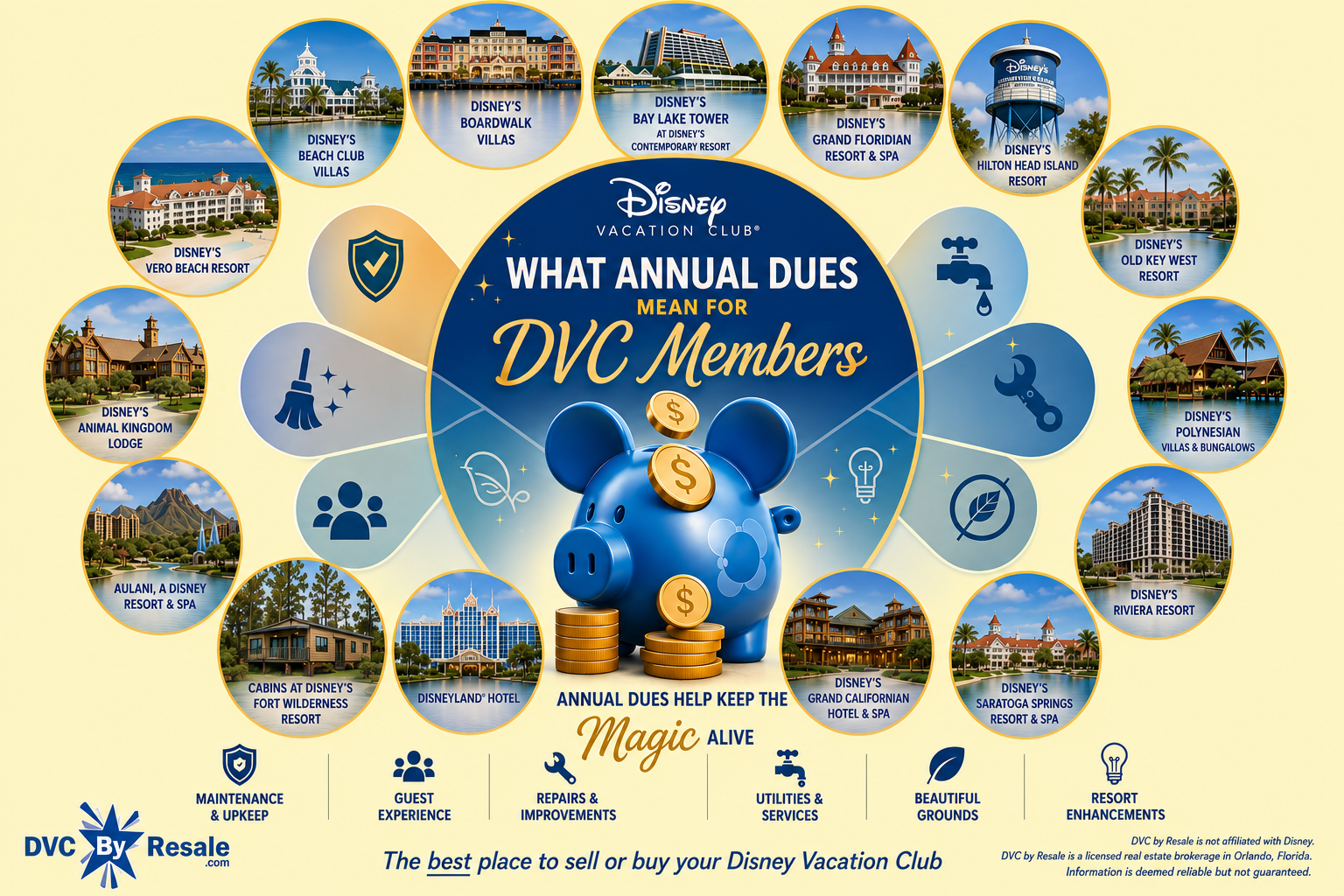
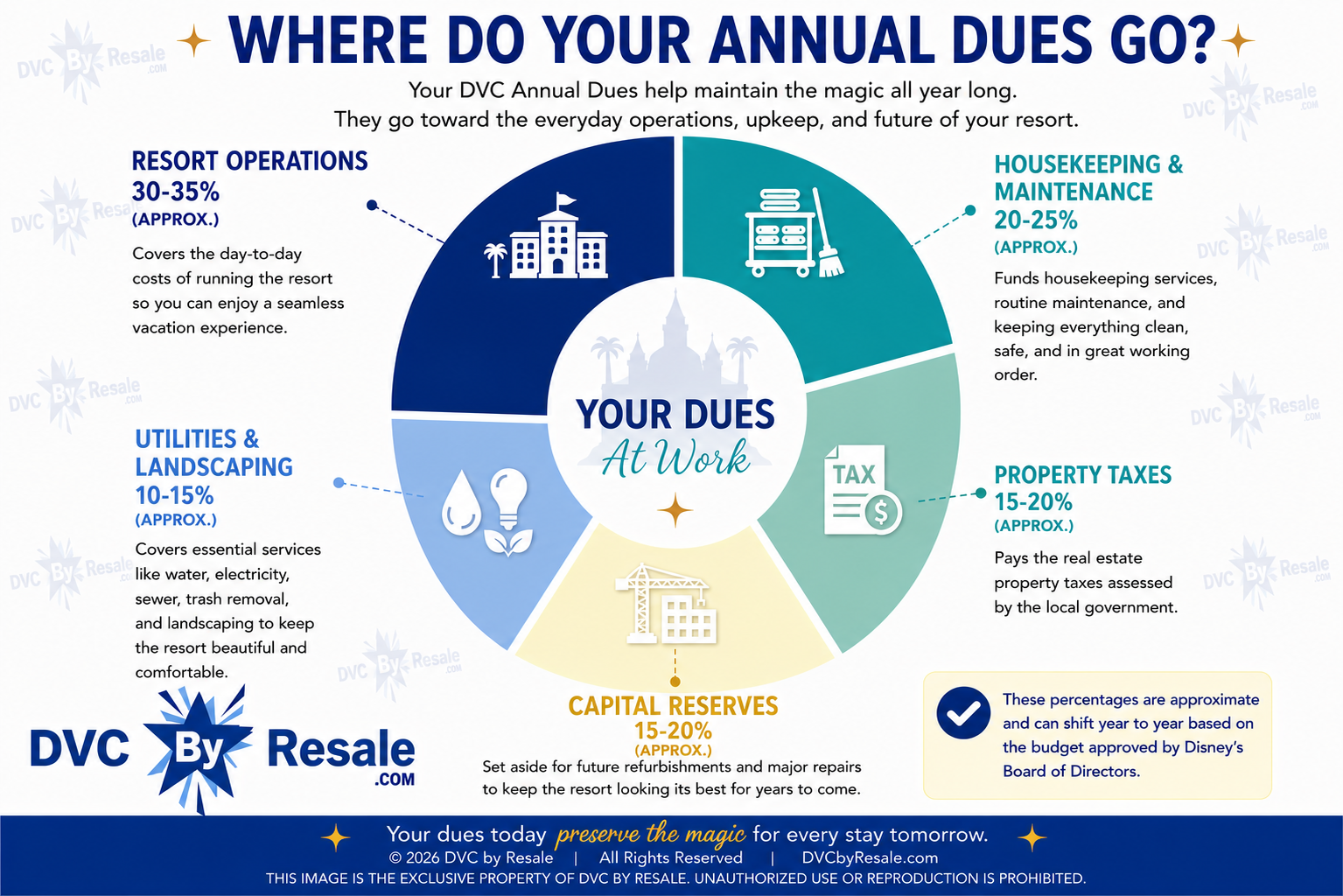
Disney Vacation Club annual dues are the yearly maintenance fees every DVC owner pays to operate, maintain, insure, and build reserves for their home resort. They are charged on a per-point basis, vary by resort and ownership type, and remain an important part of the cost whether you are buying, owning, or selling Disney Vacation Club resale. Last updated August 2, 2026. Annual dues are Disney Vacation Club maintenance fees charged according to the number of points you own. Your home resort and specific ownership type determine the per-point rate. You pay annual dues every year whether you use your points or not. Like other deeded real estate, Disney Vacation Club ownership comes with ongoing operating expenses shared by the owners. Those yearly ownership costs support the resort's operations, maintenance, insurance, property taxes, and replacement reserves. Multiply the annual dues rate for your resort and ownership type by the number of points you own: Annual dues are based on points, not on how many vacations you take. Owning more points produces a larger annual bill, and owning the same number of points at a resort with a higher per-point rate costs more each year. Disney Vacation Club annual dues are due January 15 when paid in full. For most Members, the full bill may instead be divided by 12 and paid monthly through direct checking access arranged with DVC Accounting. The rate can change after you buy because every resort prepares a new operating budget each year. Disney announces proposed dues each fall, with final approval in the December annual meetings. These are the verified 2026 annual dues rates per point, listed from lowest to highest. Rates shown are for 2026. Always confirm the current rate for the specific contract you are considering. Aulani Subsidized has the lowest published 2026 rate at $8.24 per point, followed by Grand Floridian at $8.31, Polynesian at $8.33, and Bay Lake Tower at $8.74. Vero Beach has the highest published 2026 rate at $14.89 per point, followed by Hilton Head at $12.86 and Fort Wilderness Cabins at $12.28. A lower annual dues rate can reduce long-term ownership costs, but it should not be the only reason you choose a home resort. Consider where you want to stay, the resort's point chart, use year, resale restrictions, purchase price, and the current market as well. Every Disney Vacation Club resort has its own condominium association, annual operating budget, reserve fund, insurance costs, and property tax obligations. Because each resort has different operating expenses and maintenance needs, its annual dues per point can differ from every other resort. Some resorts, including Aulani and Vero Beach, have specific subsidized ownership interests with a lower published rate. Those contracts are relatively uncommon on the resale market. Most resale contracts carry the standard, non-subsidized rate shown in the table. Smaller resorts and properties outside Walt Disney World tend to run higher because fixed costs are spread across fewer total points. Each resort's budget is unique, so the table is the best place to compare the actual current rates. In general, annual dues increase because each resort's budget must account for changing operating costs. Insurance premiums, wages, utilities, property taxes, materials, reserve studies, and refurbishment schedules can all affect the yearly rate. Dues have increased in most years since DVC began, with occasional rare exceptions. The rate is not fixed when you buy, so buyers should plan for ongoing ownership costs to change over time. For owners who purchased 10 or 15 years ago, it is not unusual for the current annual bill to be substantially higher than it was at purchase. Rising maintenance costs are one of the common reasons owners decide it may be time to sell. Your annual maintenance fees cover the costs of operating and maintaining your home resort: Owners of the same ownership type at a resort pay the same per-point rate regardless of whether they use their points that year. This is one of the most misunderstood parts of a Disney Vacation Club resale. DVC annual dues are not simply prorated by the calendar the way property taxes may be divided in a home sale. Closing adjustments are based primarily on the current calendar year's point allocation being transferred and on which party used or is receiving those points. Every contract can have a different combination of current, banked, borrowed, used, and remaining points. DVC By Resale reviews the full point allocation before a contract is listed, but the buyer's annual dues obligation is calculated only on the points from the current calendar year's allocation that the buyer is receiving. Banked points from a prior year do not create an additional dues charge to the buyer. The exact obligation is displayed on the listing's no-obligation Buy Now page, and the closing company then incorporates the agreed figures into the closing documents. The important point is that the buyer pays dues only on the points from the current calendar year's allocation that the buyer receives. Banked points from a prior year are not added to that obligation, and borrowed-point credits and other closing adjustments are handled separately. DVC By Resale shows the exact buyer costs before an offer so neither party has to wait for an estimate or discover a surprise later. Yes. Buyers consider both the purchase price and ongoing Disney Vacation Club ownership costs. Two contracts with the same number of points at different resorts can have very different long-term costs because the annual dues rates differ. Lower dues may attract more buyer interest, while higher or faster-rising dues can soften demand. Annual dues are only one part of resale value, however. Resort location, point charts, use year, resale restrictions, available points, purchase price, and current market conditions also matter. Yes. Multiply the annual dues rate for your resort and ownership type by the number of points you own. You owe dues every year whether you use the points or not. Yes. Every resort prepares a new operating budget and per-point annual dues rate each year. The rate is not fixed for the life of the contract. No. Buying resale does not create a separate annual-dues surcharge. The rate follows the specific ownership interest. A standard contract carries the standard rate, while a qualifying subsidized Aulani or Vero Beach contract carries its published subsidized rate. No. The advertised contract price and the current-year annual dues obligation are separate buyer costs. DVC By Resale shows the exact annual dues and other buyer costs on each listing's no-obligation Buy Now page before you make an offer. The closing statement handles any agreed adjustment for the current calendar year's points being conveyed. After ownership transfers, the buyer is responsible for future annual dues on the contract. If the seller's annual dues are behind or still being paid monthly, the outstanding balance is settled from the seller's proceeds at closing. Banked points from a prior year do not typically create a dues reimbursement, although having banked points available may support a higher sale price. Yes. If the seller used points borrowed from the following year, the seller would typically credit the buyer for the dues associated with those used points. Disney Vacation Club establishes a new budget and dues rate for each resort every year. Insurance, wages, utilities, property taxes, materials, reserves, and planned refurbishments can all affect the new rate. Yes, but a decrease or flat year is uncommon. Dues have increased in most years because the overall cost of operating and maintaining the resorts tends to rise over time. Aulani Subsidized has the lowest published 2026 rate at $8.24 per point. Among the standard rates in the table, Grand Floridian is the lowest of the Orlando resorts at $8.31 per point. Vero Beach has the highest published 2026 rate at $14.89 per point. Yes. For most Members, Disney offers a monthly payment option through direct checking access arranged with DVC Accounting. Otherwise, annual dues are due January 15 when paid in full. Disney will send notices and may assess late fees and interest. If dues remain unpaid long enough, Disney can initiate foreclosure proceedings. If you are considering selling and your dues are behind, it is better to list before the balance and related costs grow. Possibly. The property tax portion of annual dues may be deductible depending on your ownership interest, tax situation, whether you itemize deductions, and other IRS rules. Consult your tax professional for advice about your circumstances. Log into your DVC member account online or call Member Accounting. They can provide your current balance, payment history, and any outstanding amounts. If rising annual maintenance fees have you reconsidering your DVC ownership, you are not alone. It is one of the common reasons owners contact DVC By Resale. Get a free, no-obligation valuation on our Sell Your DVC page or call us toll-free at 1-800-844-4099. We will explain what your contract may be worth and how its points and annual dues would be handled at closing. Related reading: The DVC Resale Process | How to Sell Your DVC Points | Can You Sell Your DVC by Owner? | DVC Frequently Asked QuestionsDVC Annual Dues Explained: What Owners Pay and Why It Matters When Selling
What Are DVC Annual Dues?
How Are DVC Annual Dues Calculated?
When Are Disney Vacation Club Annual Dues Billed and Paid?
2026 DVC Annual Dues by Resort
Resort
2026 Dues Per Point
Aulani – Subsidized
$8.24
Grand Floridian
$8.31
Polynesian
$8.33
Bay Lake Tower
$8.74
Copper Creek Villas
$9.02
Saratoga Springs
$9.19
Riviera
$9.46
Grand Californian
$9.52
BoardWalk Villas
$9.67
Boulder Ridge
$9.77
Beach Club Villas
$9.81
Animal Kingdom Villas
$10.16
Disneyland Hotel
$10.54
Aulani
$10.96
Old Key West
$11.21
Vero Beach – Subsidized
$11.69
Fort Wilderness Cabins
$12.28
Hilton Head
$12.86
Vero Beach
$14.89
Which DVC Resorts Have the Lowest and Highest Annual Dues?
Lowest 2026 Dues
Highest 2026 Dues
Why Are DVC Dues Different at Each Resort?
Why Do DVC Annual Dues Increase?
What Do Disney Vacation Club Maintenance Fees Pay For?
How Are DVC Annual Dues Handled When You Sell?
How Dues Move Through a DVC Resale Closing
Do Annual Dues Affect DVC Resale Value?
DVC Annual Dues: Frequently Asked Questions
Are DVC annual dues based on points?
Can DVC annual dues change after I buy?
Do DVC resale buyers pay different annual dues than direct buyers?
Are DVC annual dues included in the purchase price?
Who pays annual dues after closing?
What happens if annual dues are not current when selling?
Do banked points affect annual dues at closing?
Do borrowed points affect annual dues at closing?
Can Disney increase annual dues every year?
Can DVC annual dues ever decrease?
Which DVC resort has the lowest annual dues in 2026?
Which DVC resort has the highest annual dues in 2026?
Can I pay DVC annual dues monthly instead of annually?
What happens if I do not pay my DVC annual dues?
Are DVC annual dues tax deductible?
How do I find out exactly what I owe in annual dues?
Thinking About Selling?
DVC Annual Dues Explained
Points owned × annual dues per point = annual duesFor example, 200 points at $9.00 per point equals $1,800 for the year, or $150 per month when divided by 12.
1. Review the PointsThe current year's allocation is reviewed to identify which points the buyer receives; banked and borrowed points are tracked separately.
2. Calculate the DuesThe buyer pays dues only on the points from the current year's allocation that the buyer is receiving.
3. Show Exact CostsThe Buy Now page displays the buyer's costs before an offer.
4. Apply Credits/DebitsThe closing company places the agreed adjustments on the closing statement.